
Good park lighting is not simply about installing bright fixtures at regular intervals.
A successful park lighting design should create sufficient visibility for pedestrians while maintaining visual comfort, appropriate light distribution, energy efficiency and harmony with the surrounding landscape.
This means designers and project buyers must consider several factors together, including:
pole height, fixture spacing, lumen output, optical distribution, color temperature, glare and site layout.
This guide explains the main factors involved in designing lighting for parks, pathways, plazas and outdoor landscape environments.
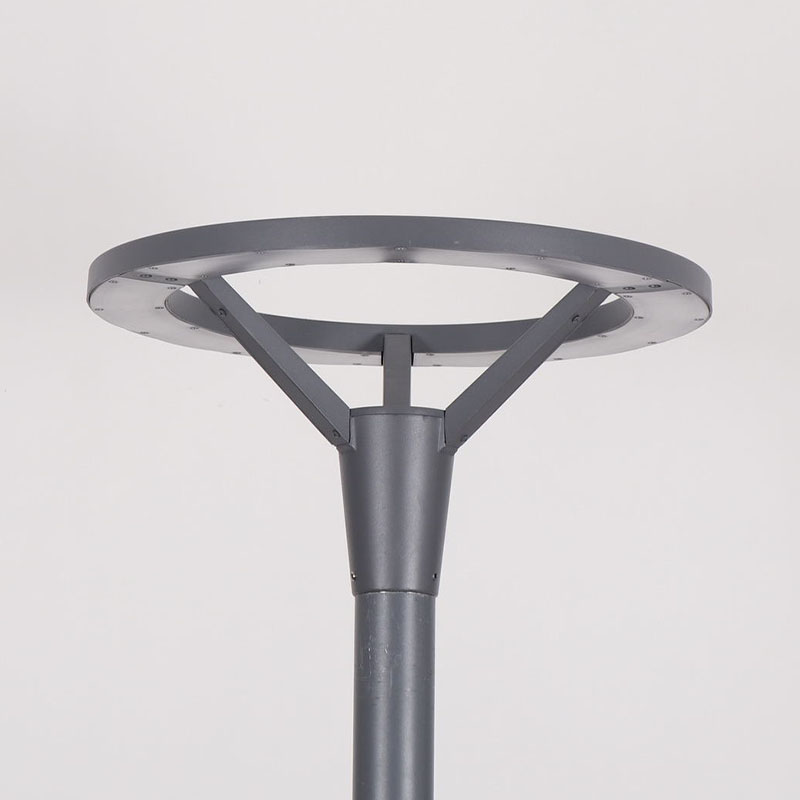
What Is Park Lighting Design?
Park lighting design is the process of determining where outdoor luminaires should be installed and how they should distribute light across a park or pedestrian environment.
The objective is not simply to maximize brightness.
Instead, a well-designed system should balance:
Pedestrian visibility
Lighting uniformity
Visual comfort
Energy use
Fixture quantity
Landscape appearance
Maintenance
Environmental impact
The correct lighting solution can vary significantly between a narrow pathway, an open plaza and a landscaped garden.
For this reason, lighting design should begin with the application rather than with a predetermined fixture wattage.
For a broader introduction to fixture selection, see our guide:
LED Park Lights: A Complete Buyer’s Guide
这里内链 Post 1。
1. Start by Dividing the Park Into Lighting Zones
Most parks contain multiple areas with different lighting requirements.
For example, one project may include:
| Area | Main Lighting Objective |
|---|---|
| Main pedestrian pathway | Visibility and uniformity |
| Secondary pathway | Comfortable orientation |
| Plaza | Wide-area coverage |
| Garden | Landscape integration |
| Entrance | Recognition and visibility |
| Seating area | Visual comfort |
| Recreational area | Functional illumination |
| Parking or access road | Vehicle and pedestrian safety |
Trying to use exactly the same pole height, spacing and wattage everywhere can create poor lighting performance.
A better approach is to divide the site into lighting zones and select suitable luminaires for each area.
2. How High Should Park Light Poles Be?
Pole height is one of the most important factors in park lighting design.
A higher pole generally allows light to cover a larger area.
However, increasing mounting height may also require greater lumen output and different optical distribution.
Lower poles can create a more pedestrian-scale appearance, but more fixtures may be required to achieve continuous illumination.
There is therefore no universal “best” pole height.
The appropriate height depends on:
Pathway width
Fixture output
Optical distribution
Required illumination
Landscape conditions
Pole spacing
Glare control
Architectural requirements
For pedestrian and landscape areas, designers often prefer relatively moderate mounting heights so that the lighting remains visually integrated with the environment.
However, final pole height should always be verified through photometric calculations.
3. How Far Apart Should Park Lights Be?
Park light spacing is another common design question.
A simple rule such as:
“Install one light every 20 meters”
is not reliable enough for professional projects.
Two fixtures with the same wattage may produce very different results because their optical systems distribute light differently.
Spacing depends on:
Mounting height
Lumen output
Beam distribution
Pathway width
Required uniformity
Fixture orientation
Surrounding obstacles
If poles are spaced too far apart, the project may develop alternating bright and dark areas.
If they are too close together, the project may use unnecessary fixtures and increase both capital and operating costs.
This is why professional lighting design should evaluate spacing and mounting height together.
4. Pole Height and Spacing Should Be Designed Together
Pole height and spacing directly influence each other.
For example:
A lower pole may provide strong illumination close to the fixture but cover a smaller area.
A higher pole may provide wider coverage but could require more lumen output to maintain sufficient illumination on the ground.
Therefore, the question should not be:
“What pole height should I use?”
or:
“How far apart should the lights be?”
Instead, the better design question is:
What combination of mounting height, spacing, luminaire output and optical distribution produces the required lighting performance?
This is one of the main reasons photometric simulation is important for larger park projects.
5. Do Not Choose Park Lights Based on Wattage Alone
Wattage is commonly used during outdoor lighting procurement, but wattage only tells you how much electrical power the fixture consumes.
It does not tell you how well the area will actually be illuminated.
A professional lighting design should evaluate:
Lumens + optical distribution + mounting height + spacing
rather than wattage alone.
For example, two 60W LED park lights may have:
Different lumen outputs
Different efficiencies
Different optical systems
Different light distributions
As a result, their actual ground illumination may be very different.
6. Understand Lumens and Illuminance
Lumens measure how much visible light a luminaire produces.
However, designers are usually more interested in how much of that light reaches the target surface.
This is commonly evaluated using illuminance, usually expressed in lux.
In simple terms:
Lumens = total light produced
while:
Lux = light reaching a surface
This distinction is important.
A luminaire can produce a high number of lumens but still perform poorly if much of that light is directed outside the intended area.
Therefore, fixture efficiency and optical distribution should always be evaluated together.
7. Light Distribution Is Critical in Park Lighting
Optical distribution determines where the luminaire sends its light.
For example, a pathway may benefit from a distribution pattern that extends along the walking route.
A plaza may require wider coverage.
A circular landscape area may require a different distribution again.
Poor optical distribution may create:
Dark areas between poles
Excessive brightness near the pole
Glare
Light spill
Upward light
Inefficient fixture layouts
For this reason, buyers should request:
IES photometric files
when evaluating fixtures for a project.
These files allow lighting designers to simulate how a luminaire performs within a specific layout.
8. Why Uniformity Matters
Average illuminance alone does not tell the full story.
Imagine two pathways.
Both have the same average illuminance.
However, the first pathway has relatively consistent lighting, while the second alternates between bright areas and dark areas.
Pedestrians will usually experience the first environment as more comfortable and visually predictable.
This is why uniformity is an important part of lighting design.
Better uniformity can help:
Improve pedestrian visibility
Reduce strong brightness contrasts
Improve visual comfort
Make pathways easier to navigate
Fixture spacing and optical distribution play major roles in achieving good uniformity.
9. Consider Glare, Not Just Brightness
More light does not always mean better lighting.
A luminaire can produce sufficient ground illumination while still creating uncomfortable glare.
This can occur when bright LED sources are directly visible from normal viewing angles.
In parks and pedestrian environments, excessive glare may reduce visual comfort and interfere with the appearance of the landscape.
Designers should therefore consider:
Luminaire mounting height
Optical shielding
LED source visibility
Fixture orientation
Surrounding pedestrian sightlines
Post top luminaires with well-designed optical systems can help control the way light is distributed.
10. Choose an Appropriate Color Temperature
Color temperature affects the visual atmosphere of the park.
Typical outdoor LED options include:
2700K–3000K
Provides a warmer appearance and is often suitable for:
parks, gardens, residential communities and landscape environments.
4000K
Provides a more neutral appearance and is commonly considered for:
campuses, public spaces and commercial landscapes.
5000K and Above
Produces a cooler visual appearance and may be selected where high perceived brightness is preferred.
For pedestrian and landscape environments, warmer color temperatures are increasingly considered where visual comfort and nighttime environmental impact are important.
The appropriate choice should depend on project requirements and local regulations.
11. Use Different Fixtures for Different Park Areas
One of the most common mistakes in park lighting design is trying to use one luminaire for every application.
A park may require several different fixture types.
For example:
Post top lights may be used along pathways and landscape areas.
Bollard lights may be used for low-level pathway guidance.
Area lights may be suitable for larger circulation zones.
Architectural lighting may be used to highlight landscape features.
The best lighting design often combines multiple fixture types rather than relying on one product everywhere.
For more information about selecting post top luminaires, see:
How to Choose Post Top LED Lights for Parks and Landscapes
这里内链 Post 2。
12. How to Design Lighting for Park Pathways
Pathways are one of the most important areas in park lighting.
A good pathway lighting layout should provide enough visibility for pedestrians to understand:
Path boundaries
Direction of travel
Nearby obstacles
Changes in level
Other people
Surrounding landscape features
Fixtures should therefore be placed in a way that minimizes dark gaps along the route.
The required spacing depends on:
path width + pole height + optics + lumen output + target lighting performance
rather than on a fixed spacing rule.
Curved pathways may also require more careful fixture positioning than straight paths.
13. How to Design Lighting for Plazas
Plazas and open spaces usually require broader coverage than narrow pathways.
Designers may need to consider:
Fixture distribution
Pole height
Pedestrian circulation
Seating areas
Landscape features
Nearby buildings
A wider optical distribution may reduce the number of poles required, but the design should still maintain good uniformity.
Plazas may also require greater attention to visual appearance because lighting fixtures form part of the architectural environment.
14. Trees and Landscaping Can Affect Lighting Performance
Lighting calculations should not be performed without considering the actual landscape.
Trees, shrubs and architectural features can block light.
This means a layout that appears effective on a simple plan may perform differently after vegetation matures.
Designers should consider:
Tree canopy
Seasonal growth
Shrubs
Structures
Signage
Benches
Landscape walls
Poles should also be positioned so that routine maintenance remains practical.
15. Why DIALux or Photometric Simulation Matters
For larger commercial or municipal projects, photometric simulation is strongly recommended.
Software such as DIALux can be used to model:
Pole positions
Mounting height
Fixture orientation
Lighting levels
Uniformity
Light distribution
Different fixture options
The manufacturer typically provides an IES file or other photometric data for each luminaire.
This allows the designer to test different layouts before fixtures are installed.
Simulation can help avoid two expensive problems:
under-lighting, where the finished project does not provide enough useful illumination,
and
over-lighting, where unnecessary fixtures and power are used.
16. Example: Designing With a Post Top Park Light
Consider a project that includes:
a pedestrian pathway, a landscaped garden and a small public plaza.
A post top LED fixture such as the JHTY-9028 Outdoor LED Park Light may be considered for these types of environments.
The JHTY-9028 offers:
| Specification | JHTY-9028 |
|---|---|
| Rated Power | 30W / 60W |
| Color Temperature | 2700K–6500K |
| Input Voltage | AC 85–265V |
| Power Factor | PF >0.9 |
| CRI | >70 |
| Protection Rating | IP65 |
| Housing | High-pressure die-cast aluminum |
| Cover | PC |
| Operating Temperature | -40°C to +60°C |
| LED Lifetime | >50,000 hours |
| Installation Spigot | Ø60 mm |
The 30W and 60W configurations provide different output options depending on the size and layout of the area being illuminated.
However, the final selection should not be based on wattage alone.
The appropriate configuration should be confirmed using project dimensions and photometric calculations.
这里直接链接:
JHTY-9028 Outdoor LED Park Light
https://www.jinhuilighting.com/FeaturedProducts/outdoor-led-park-light-jhty-9028.html
17. A Simple Park Lighting Design Workflow
For commercial projects, a practical lighting design process can follow this sequence:
Site analysis → lighting zones → target performance → fixture selection → pole height → initial spacing → photometric simulation → adjustment → final specification
In practical terms:
First, identify pathways, plazas, entrances and landscape areas.
Then define the intended lighting function for each zone.
Select suitable fixture types and preliminary mounting heights.
Request IES files from the manufacturer.
Build a photometric model.
Review illuminance, uniformity and glare.
Then adjust pole spacing or fixture output until the layout meets project requirements.
Only after this process should the final fixture quantity be confirmed.
Common Park Lighting Design Mistakes
Several common mistakes can reduce project performance.
The first is selecting fixtures only by wattage.
The second is using fixed pole spacing without checking photometric performance.
The third is ignoring glare.
The fourth is placing poles without considering trees and landscape elements.
The fifth is selecting fixtures without checking pole compatibility.
The sixth is skipping photometric simulation on larger projects.
The seventh is focusing only on initial fixture price while ignoring maintenance and operating costs.
Avoiding these mistakes can significantly improve both project performance and long-term cost efficiency.
Frequently Asked Questions
How far apart should park lights be?
There is no universal spacing suitable for every project. Spacing depends on pole height, fixture output, optical distribution, pathway width and required uniformity. Photometric simulation should be used for larger projects.
How high should park light poles be?
Pole height depends on the application, fixture optics and target lighting performance. Lower poles may create a more pedestrian-scale environment, while higher poles can cover larger areas. The final height should be evaluated together with spacing and photometric performance.
How many lumens are needed for park lighting?
The required lumen output depends on the illuminated area, mounting height, fixture efficiency and optical distribution. Designers should focus on the required ground illumination rather than selecting fixtures based on lumen output alone.
What color temperature is best for park lighting?
Warm white options such as 2700K–3000K are often suitable for pedestrian and landscape environments, while 4000K may be selected for public and commercial spaces. The final choice depends on project objectives and local requirements.
Should I use DIALux for park lighting design?
For medium and large projects, photometric simulation is strongly recommended. Software such as DIALux allows designers to evaluate light levels, uniformity, pole spacing and fixture performance before installation.
Are post top LED lights suitable for parks?
Yes. Post top LED lights are commonly used in parks, pathways, plazas and landscape environments because they combine functional lighting with an architectural appearance.
Plan Park Lighting Around Performance, Not Wattage
Successful park lighting requires more than choosing attractive fixtures and placing poles at regular intervals.
A professional design should consider:
pole height + spacing + lumens + optics + uniformity + glare + CCT + landscape conditions
as one complete system.
For project owners, contractors and lighting designers, photometric simulation can help confirm whether a proposed fixture layout will provide the required performance before installation begins.
Jinhui Lighting provides outdoor LED lighting solutions for parks, pathways, landscapes and other commercial outdoor environments.
For product specifications, IES files or project lighting support, contact our team to discuss your application.
Post time: 2026-09-11