
LED park lights play an important role in creating safe, comfortable and visually appealing outdoor environments. From public parks and pedestrian pathways to residential communities, plazas, campuses and commercial landscapes, the right lighting system can improve nighttime visibility while also reducing energy and maintenance costs.
However, choosing LED lights for a park project involves much more than simply comparing wattage.
Lighting designers, contractors, distributors and project owners should also consider lumen output, light distribution, mounting height, color temperature, environmental protection, glare control and the overall appearance of the luminaire.
This guide explains the key factors to consider when selecting LED park lights for outdoor projects.
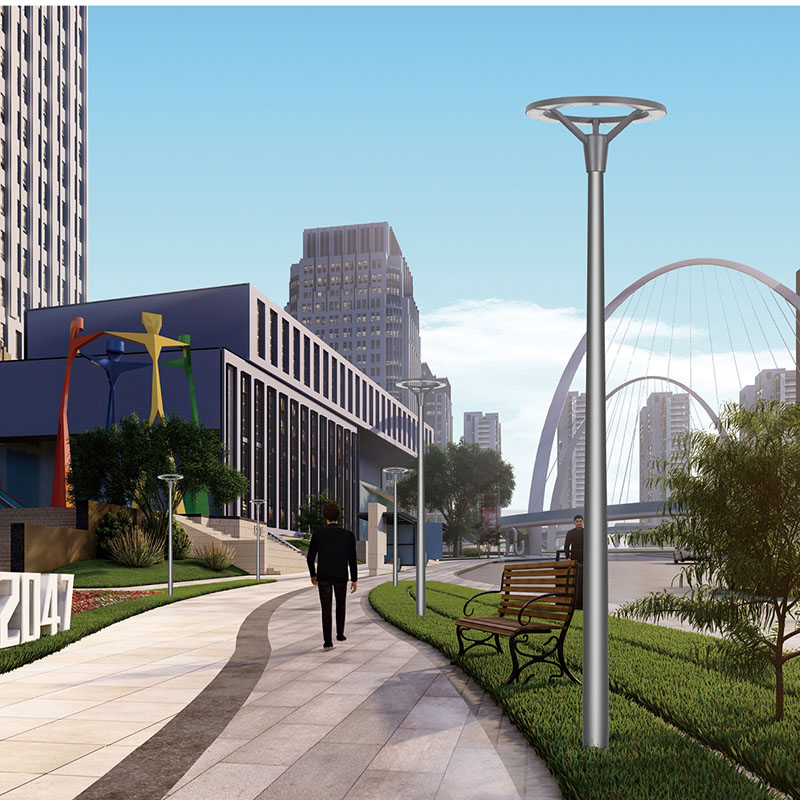
What Are LED Park Lights?
LED park lights are outdoor luminaires designed to illuminate pedestrian and landscape environments such as:
Public parks
Walking paths
Plazas
Residential communities
Campuses
Gardens
Recreational areas
Commercial landscapes
Pedestrian streets
Outdoor gathering spaces
Unlike high-output roadway or industrial area lights, park lighting often has to balance visibility, visual comfort and architectural appearance.
For this reason, many park lighting fixtures use decorative post-top or pole-mounted designs that integrate naturally into landscape environments.
Modern LED technology also gives project designers greater control over efficiency, optical distribution and lighting controls than many traditional light sources.
Why Are LED Lights Widely Used for Park Lighting?
1. Higher Energy Efficiency
One of the main reasons LED technology has replaced conventional outdoor lighting is its ability to generate more useful light while consuming less electrical power.
For buyers, it is therefore more useful to compare luminaire efficacy in lumens per watt (lm/W) rather than looking only at fixture wattage.
The U.S. Department of Energy likewise evaluates exterior luminaires using luminaire efficacy, and its current federal purchasing guidance includes separate efficiency criteria for outdoor pole-mounted decorative luminaires. The Department of Energy's Energy.gov
2. Lower Maintenance Requirements
Park lighting systems are often installed on poles across large outdoor areas.
Replacing lamps frequently can therefore create significant labor and equipment costs, particularly when maintenance requires lifting equipment or temporary closure of public areas.
A properly designed LED luminaire can reduce routine lamp replacement and simplify long-term maintenance planning.
For commercial projects, buyers should therefore consider not only the initial fixture price but also:
Rated lifetime
Driver quality
Thermal management
Replacement accessibility
Warranty
Availability of spare components
3. Better Control of Light Distribution
Lighting a park does not mean simply producing as many lumens as possible.
The light needs to reach the right area.
For example, a pedestrian pathway may require a different distribution pattern from an open plaza or landscape area.
Professional outdoor luminaires use optical systems to direct light toward the target surface, helping project designers achieve better uniformity while reducing unnecessary light.
This makes photometric information, such as IES files and light distribution curves, especially valuable during project selection.
4. Flexible Color Temperature
Correlated color temperature, or CCT, affects the visual character of an outdoor environment.
Typical LED options may include:
3000K — Warm White
Creates a softer and warmer nighttime atmosphere and is often suitable for landscape, residential and pedestrian-oriented applications.
4000K — Neutral White
Provides a cleaner and relatively neutral appearance and is commonly considered for commercial and public outdoor spaces.
5000K — Cool White
Produces a cooler visual appearance and may be selected for applications where high visual brightness is prioritized.
The appropriate CCT should ultimately depend on the project environment, local regulations and lighting objectives.
For environmentally sensitive applications, lower CCT options can be particularly relevant. DarkSky International, for example, limits products eligible for its Approved Luminaires program to a maximum CCT of 3000K and also places emphasis on shielding and dimming. DarkSky International
How to Choose LED Park Lights
1. Start With the Application
Before selecting a fixture, determine where the lighting will actually be used.
A park may contain several lighting zones:
| Application | Main Lighting Consideration |
|---|---|
| Pedestrian pathway | Visibility and uniformity |
| Plaza | Wider area coverage |
| Garden | Visual comfort and landscape integration |
| Residential community | Appearance and controlled brightness |
| Campus | Safety, consistency and maintenance |
| Recreational area | Coverage and durability |
One luminaire does not necessarily suit every area.
Therefore, project specifications should start with the application and required lighting performance, rather than a predefined wattage.
2. Compare Lumens, Not Wattage Alone
Wattage tells you how much electrical power a luminaire consumes.
Lumens describe its light output.
Two LED park lights with the same wattage may produce very different lumen outputs because of differences in:
LED efficiency
Driver efficiency
Optical losses
Thermal design
Luminaire construction
A more useful comparison is therefore:
Lumens + Wattage + Luminaire Efficacy
instead of:
Wattage alone.
3. Check the Light Distribution
This is one of the most important factors in professional park lighting.
The fixture must distribute light appropriately across the intended area.
Poor distribution can create:
Dark areas
Excessive bright spots
Poor uniformity
Unnecessary spill light
Higher fixture quantities
Uncomfortable glare
Before placing a large order, project buyers should consider requesting:
IES photometric files
from the manufacturer.
These files can be imported into lighting design software such as DIALux or similar photometric software to evaluate the proposed installation.
Post Top Lights vs Other Park Lighting Fixtures
Several luminaire types can be used in park projects.
Post Top LED Lights
Post-top luminaires are mounted directly on top of a lighting pole.
Their appearance makes them particularly suitable for:
Parks
Gardens
Plazas
Residential developments
Pedestrian areas
Landscape projects
They combine functional lighting with an architectural or decorative appearance.
For buyers considering this type of luminaire, our upcoming guide How to Choose Post Top LED Lights for Parks and Landscapes will explain optical design, installation and procurement considerations in more detail.
Bollard Lights
Bollards are relatively low-mounted fixtures commonly used alongside pathways, entrances and landscape areas.
They can provide localized lighting but are generally not a direct substitute for taller pole-mounted luminaires when wider coverage is required.
Street and Area Lights
Street or area luminaires are normally designed for roads, parking areas and large circulation spaces.
They may prioritize higher mounting heights and wider roadway or area distribution rather than decorative landscape integration.
This is also why buyers should avoid treating all outdoor luminaires as interchangeable simply because they produce similar lumen outputs.
What IP Rating Should an Outdoor Park Light Have?
Outdoor fixtures are continuously exposed to environmental conditions such as:
Rain
Dust
Humidity
Wind
Temperature changes
For this reason, buyers should check the luminaire's IP rating.
The appropriate protection level depends on the project location and installation environment.
In addition to the IP rating, commercial buyers should also evaluate:
Housing construction
Sealing design
Cable entry
Driver compartment protection
Corrosion resistance
Surface treatment
For coastal or highly corrosive environments, material and coating performance may become particularly important.
Housing and Thermal Management
Heat management directly influences the performance and lifetime of LED components.
A well-designed outdoor LED luminaire should allow heat generated by LEDs and electronic components to dissipate effectively.
Die-cast aluminum housings are widely used in outdoor luminaires because they can provide:
Structural strength
Effective thermal conduction
Weather resistance
Manufacturing consistency
However, buyers should evaluate the complete luminaire design rather than selecting a fixture solely based on housing material.
Consider Maintenance Before Installation
Maintenance is often overlooked during procurement.
Before selecting a park luminaire, consider questions such as:
How is the fixture opened?
Can the driver be replaced?
Does routine maintenance require removing the entire luminaire?
Are replacement components available?
How is the luminaire attached to the pole?
For a park containing hundreds of lighting points, even a small difference in maintenance time per fixture can create a significant long-term operational difference.
Lighting Controls Can Further Reduce Energy Use
LED park lighting can also be integrated with control systems.
Depending on project requirements, these may include:
Photocells
Timers
Dimming
Motion sensors
Scheduled lighting
Centralized lighting control
The U.S. Department of Energy notes that exterior lighting controls can contribute to additional energy savings and operating-cost reductions beyond luminaire efficiency alone. The Department of Energy's Energy.gov
For parks with changing pedestrian activity throughout the night, controls can therefore be an important part of the overall lighting strategy.
How High Should Park Lights Be Installed?
There is no universal pole height suitable for every park.
The appropriate mounting height depends on factors including:
Pathway or area width
Target illuminance
Luminaire output
Optical distribution
Pole spacing
Landscape layout
Glare requirements
Local standards
Instead of selecting pole height independently, pole height and spacing should be designed together with luminaire photometrics.
We cover this topic in detail in:
Park Lighting Design Guide: Pole Height, Spacing & Lumens
Professional pedestrian lighting recommendations also consider more than illuminance alone, including visual, environmental and glare considerations.
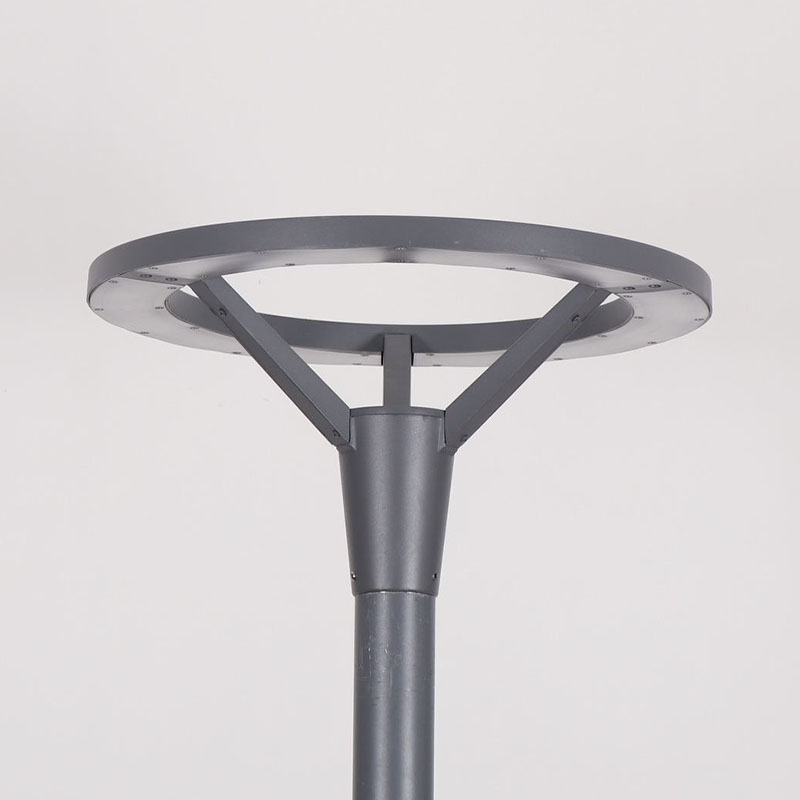
JHTY-9028 Outdoor LED Park Light
For projects requiring a modern post-top luminaire, Jinhui Lighting offers the JHTY-9028 Outdoor LED Park Light.
It features an aluminum die-cast housing, secondary optical distribution design and a UV-resistant PC cover and is designed for outdoor applications such as parks, pathways and landscape environments.
What Should Buyers Ask an LED Park Light Manufacturer?
Before purchasing fixtures for a commercial project, consider requesting the following information:
Product datasheet
Wattage options
Lumen output
Luminaire efficacy
CCT and CRI options
Optical distribution
IP / IK rating
IES files
Installation dimensions
Pole compatibility
Driver information
Certifications
Warranty
Packaging information
Lead time
For larger projects, lighting simulation and sample evaluation may also help confirm whether the selected fixture meets the intended application.
Frequently Asked Questions
What is an LED park light?
An LED park light is an outdoor luminaire designed to illuminate parks, pathways, plazas, gardens and other pedestrian or landscape environments. Post-top and pole-mounted fixtures are commonly used for these applications.
How many watts should an LED park light be?
There is no single wattage suitable for every project. The appropriate output depends on mounting height, pole spacing, optical distribution, target lighting levels and the size of the illuminated area. Buyers should compare lumens and photometric performance rather than wattage alone.
What color temperature is suitable for parks?
3000K and 4000K are commonly considered for pedestrian and landscape environments, while the final choice depends on project objectives and local requirements. Projects concerned with minimizing nighttime environmental impact may prefer warmer CCTs.
Are IES files important when choosing park lights?
Yes. IES photometric files allow designers to simulate how a luminaire distributes light within a specific project layout and can help evaluate coverage, uniformity and fixture spacing before installation.
What is the difference between a post top light and a street light?
A post-top fixture is mounted on top of a pole and is frequently selected for pedestrian and landscape environments where appearance is important. Street lights are generally designed primarily for roadway illumination and typically use different optical distributions and mounting configurations.
Choosing the Right LED Park Light for Your Project
Selecting LED park lights should involve more than comparing fixture prices or wattages.
A successful park lighting project should consider:
Lighting performance + optical distribution + durability + visual comfort + energy efficiency + maintenance + landscape design.
For contractors, distributors and project owners, evaluating these factors at the specification stage can help reduce installation problems and improve long-term lighting performance.
Jinhui Lighting provides outdoor lighting solutions for parks, landscapes and other commercial outdoor projects.
For product specifications, photometric information or project inquiries, contact our team to discuss your lighting requirements.
Post time: 2026-09-11